Great designers like Verner Panton, Georg Jensen and Arne Jacobsen don’t come along every day. Nor do they simply appear out of the ether. Talent needs nurturing and that’s what Heal’s Discovers is all about. Unearthing the brilliance in our midst.
Each year we bring together the work of the best up-and-coming furniture and homeware designers in an exclusive Heal’s Discovers collection. This Autumn, eight inspiring new designers are making their debuts, showcasing innovative furniture, textiles, crafted sculptures and original artwork.
|
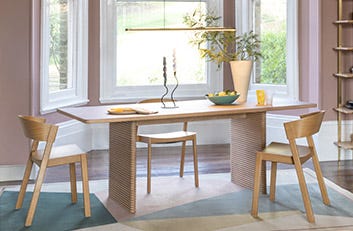
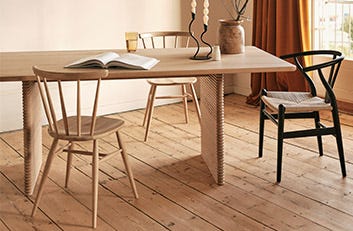
The K series, comprising chair, loveseat and dining table, has the look of an instant contemporary classic - all the more remarkable considering its creator, Erik Järkil, has no formal training in furniture design.‘I experimented on the K series for a long time,’ says Järkil, who lives and works in Gothenburg, Sweden.‘It was an intuitive process, constantly sketching and seeing what was possible. I wanted to explore the potential and the limits of wood, and use it in an original way. The shape gives the impression of instability, and of being impossible delicate – but in reality it’s very strong and very stable.’
Järkil began designing furniture in 2004, inspired by Danish master Hans Wegner. ‘Perhaps it was naïve of me to think I could reintepret something as iconic as the chair,’ he laughs. ‘But my family worked in handcrafts so I grew up surrounded by all kinds of furniture. That got me interested in forms that support the human body.' Erik Järkil is now studying architecture, but hopes to continue designing furniture and even has plans to try his hand at fashion. Whatever the discipline, he is definitely a name to watch in the future.
|
Geometry by Burgundy Applegate
Burgundy Applegate hails from New England, where she studied furniture design at the Rhode Island School of Design before moving to the UK in 2003. As a long-time admirer of the Arts and Crafts movement, she is especially excited to be involved with Heal’s Discovers. ‘I’ve always loved the Heal’s heritage,’ she says, ‘the idea of surrounding yourself with furniture that functions well but is beautiful. People sometimes forget that design can achieve both – you don’t have to compromise.’
Applegate’s Geometry series was inspired by the pared-down aesthetic of Danish Modern design and the fluid lines of Art Nouveau. For the surface of her triangular side table, pentagonal coffee table and compact sideboard she developed a technique using sticky-backed vinyl and spray lacquer, cutting the vinyl into a one-use stencil and then spraying over it to give a layered, two-tone effect. ‘For the pattern,’ she says, ‘I wanted to create something that was geometric but with a natural, organic feel.’ All three pieces have a walnut frame with tops in either plain grey or a lime green pattern. The side table is also available with a plain green lacquer top.
|
A graphic designer by trade, Samantha Neal came up with the idea for her innovative 3D wall art while designing a pocket for appointment cards. ‘I was working for a client whose logo is four curves, almost like a four leaf clover,’ she recalls. ‘I cut the logo into a piece of card and then accidentally brushed past it. The cut part was slightly raised and I thought, “Oh, that reminds me of a butterfly.” So I started experimenting with cutting other shapes, which eventually led to me making a large-scale piece of wall art my own house.’
This in turn attracted the attention of a friend, who asked her to make her a smaller version as a wedding present. Seeing the interest her technique was generating, Samantha Neal contacted Heal’s. The five designs she created for Heal’s Discovers are made using a single sheet of 300g card, laser cut so when you raise certain areas you get a 3D effect. This is then placed in a 15mm-deep Perspex box frame, enabling you to see the object from different angles.‘My ultimate goal is to make a huge version to take into the art gallery sphere,’ says Neal. ‘A very detailed butterfly, perhaps. That would have a real wow factor.’
|
Leonhard Pfeifer’s Drum design started out as an idea for a lampshade. ‘I was playing around with the idea of making a lampshade using two wooden discs joined by strips of wood and thinking about how that would create interesting shadows in a room,’ says the New Zealand-born designer. ‘But then I tried it out as a side table and coffee table and loved the way it worked. The objects may be different but it’s still essentially about the interplay of shadow and light.’
Early variations had wooden strips going all the way round but Leonhard Pfeifer decided to leave a gap, allowing access to the middle of the ‘drum’ and making the tables a great place to store books and magazines. Oak was the natural choice when it came to materials because, as he says, ‘Oak is part of the Heal’s heritage.' The son of an antique restorer, Pfiefer has a love of wood in his genes, though it wasn’t until his late 20s that he started designing furniture, establishing his studio in East London in 2004. ‘My goal is to create honest designs with simple function and a clean style,’ he says. ‘Quality is the key – quality in design, manufacture and materials.’
|
Symmettree and Circle Line by Laura Thomas
Born and brought up in Pembrokeshire, West Wales, Laura Thomas is an award winning woven textile artist and designer, known for her bold contemporary designs in vibrant colours and striking geometric repeat patterns. Now based in Cardiff, Thomas has created two original designs for Heal’s Discovers. Her Circle Line throw and cushion and Symmetree bed throw and cushion are all in ‘double cloth’ – a traditional method used to make Welsh blankets.
‘My goal was to design strong statement pieces that add pattern, colour and interest to a room,’ says Thomas. ‘With double cloth you have to work with very strict parameters, in blocks. You have to use lines, squares and rectangles. This encourages geometric graphic designs and the use of bold colours – both of which pervade all of my work as an artist and a designer. I see the boundaries set by the loom not as a hindrance but as an opportunity.’ The 100% lambswool designs were woven at the renowned Welsh mill Melin Tregwynt, with whom Thomas has collaborated since the late 1990s. ‘Melin Tregwynt is a great example of a traditional manufacturing company that has embraced contemporary design very successfully,’ she says. ‘It’s Welsh heritage but with a contemporary twist.’
|
Reinventing the nest of tables might seem an ambitious goal, but Kirsty Whyte’s Twist succeeds in putting a fresh spin on this classic space-saving concept. Not only do the solid oak tables with white powder-coated aluminium legs swivel round to form an interconnected chain, they can also be pulled apart and used separately. 'One leg of each of the smaller tables is tubular so the leg of the larger table slides into it,’ Whyte explains. ‘I’m really interested in modular designs that have a kinetic element. I love the idea of people being able to move a product around to suit their own personal needs.’
The same theory applies to Nesting, Whyte’s other Heal’s Discovers design, a modular candlestick you can pull apart and reassemble to create your own customised centrepiece – an idea she came up with while playing around with OXO cubes. The east London–based designer graduated in 2003 from Nottingham Trent University, where she gained a First in decorative arts, but prior to setting up her design brand Kirsty Whyte she worked for four years in retail. ‘Just to be associated with the Heal’s name is amazing,’ she says. ‘It’s a great launching platform for any young designer.’
|
Sculptor and master craftsman Liam O’Neil has been turning wood for 42 years, opening his own studio and wood sculpture garden on the shores of Galway Bay in 1992. Having spent a lifetime studying the physiology of trees and the individual characteristics of different woods, O’Neill avoids embellishment and ornate decoration in his work, preferring to allow the natural grain, contours and patina of wood to take centre stage.
His hand-turned and hand-finished Vessels range for Heal’s Discovers was designed to be decorative as much as functional. The polished beechwood bowls have a ridged lip while the vases are made of redwood blackened with fire and then oiled – a technique O’Neill has employed for many years on his acclaimed series of large-scale outdoor sculptures. ‘The burning process removes the softer summer wood and leaves the grain lines standing proud, almost like sandblasting,’ he explains. ‘It gives the wood a really interesting texture and a lovely tactile feel.’
|
Inspired by the 1950s telephone seat, Alex Bradley’s Exchange is a versatile combination of seating and storage designed to fit seamlessly in a range of settings, whether as hallway storage or as a secondary sofa in the sitting room.
‘The telephone seat was a classic mid-century modern piece,’ explains Bradley, who was voted Young Designer of the Year at the 2011 Homes & Gardens Awards. ‘With Exchange, my aim was to create a contemporary interpretation of this traditional item, but make it relevant for today. I thought a great deal about dimensions and how it would be most useful. It’s a compact design that maximises the use of space, making it ideal for a city apartment.’The Exchange’s seat lifts up to provide storage while the side section provides a handy nook for books or magazines. The bench is made from solid oak and has splayed legs, a nod to mid-century modern design, but updated with a more contemporary grey felt to give it a timeless quality.