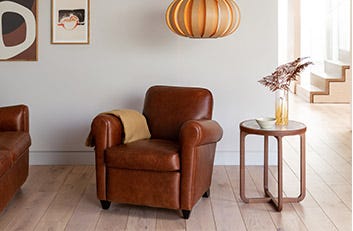
2010 Luna Chair
by Matthew Hilton.
Part of our Heal's ReDiscovers collection to celebrate our Bicentenary. Matthew Hilton, designer of the iconic Balzac chair drew inspiration from the classic wing-backed armchair to create Luna. Made in the United Kingdom, Luna is manufactured from traditional materials associated with handcrafted upholstery yet engages in new techniques of construction to create a unique, contemporary form. It combines a hardwood frame and soft quiltedinterior to provide a pure, soft, fluid profile. Its high back and scooped arms are designed to almost cradle the user, providing exceptional comfort and style. Referencing designs such as the Eames lounger which shares a contrast between the hard texture of the wood and the soft leather cushion, for Luna, Hilton has achieved a similar effect, but using only fabric to create a very controlled accurate form.
Matthew Hilton graduated with a degree in Furniture Design in 1979. He has produced seminal furniture such as the Balzac chair and the Flipper table. “I became aware of Heal’s as a designer, after I moved to london when I was about 18. I began to realise that it has always been a name in the home products market because of its passion for innovation and, as a result, it is a name that commands respect. As a company, Heal’s has always been known to do its own thing, and not play safe. These are principles that I try to adhere to in my own work.”
Knit by Donna Wilson.
During the 1940s thriving and buoyant again after the Depression, the Mansard Gallery at Heal’s was dedicated to supporting home grown Arts & Crafts, showcasing fine art, illustration, hand woven fabrics and pottery. Donna Wilson, a graduate from the Royal College of Art where she studied mixed-media textiles, is one of a new generation of designers who have taken craft to a new level using handcrafted techniques including felting, sewing, knitting and wrapping.
The three designs which form Knit are Leaf, Fox and Owl. Already inspired by nature and children’s drawings, Wilson has also taken inspiration from textile designer Dorothy Taylor’s 1944 ‘Toy Huntsmen’ and Hannah Gabert’s 1948 ‘Feathers’ which were designed exclusively for Heal’s. Designed to bring a little softness, pattern and colour into the home, Knit is playful, tactile and bright.
'The ReDiscovers project was really exciting, as I was able to draw inspiration from a fantastic rich source as the Heal’s archive. It was a great starting point, and I feel the results have a contemporary feel as well as a hint of nostalgia.' Donna Wilson.
Since graduating from the Royal College of Art with an MA in Mixed Media (Constructed Textiles) in 2003, Donna Wilson has been making her name in British design circles as a 3D designer working with knit, producing quirky dolls, alongside graphic patterned cushions and rugs.
Hobart Candlestick
by Robert Welch
In 1967 from September 11th to 30th, Heal’s exhibited a collection of work by designer Robert Welch R.D.I., M.B.E. One of the showcased designs was the Hobart candlestick which was featured on the exhibition catalogue cover. Reissued for Heal’s ReDiscovers, Robert Welch’s timeless design has been recreated by his daughter Alice. Using the original 1960s moulds Hobart’s natural imperfections add to its authentic charm. In a matt black, gloss white and gloss red enamel finish Hobart is a design classic and looks and feels as contemporary today as it did when it was first launched.
'The use of cast iron was not readily acceptable as a metal for tableware, so this range was a brave step in the 1960’s. It stands as testament to Robert’s timeless design that this range is still selling five decades later.' Alice Welch.
Robert Welch trained as a Silversmith at Birmingham College of Art. He then moved to the Royal College of Art in 1952, where he specialised exclusively in stainless steel production design. In 1967 Heal's exhibited a collection of work by designer Robert Welch. One of the showcased designs was the Hobart Candlestick which was featured on the exhibition catalogue cover.
Vanity Dressing Table and Stool by Johnny Egg.
Vanity is a perfect blend of modern and vintage, with its use of sleek black lacquer and classic sweeping scroll shape revealing Egg's trademark playful use of vibrant hot pink flocking. Inspired by Ambrose Heal's 1898 Fine Feathers Suite dressing table which was carved with the Rudyard Kipling quotation, 'If this be vanity, who'd be wise?' The same quotation is inlayed inside Vanity's drawer. Other small but noticeable and important details include the use of Swarovski crystals on the fixtures and fittings. Made in the UK.
'Ambrose Heal realised all those years ago that great design and quality wasn't something that could be put together in five minutes. He took great care and time into making his beautiful pieces, then rewarded his customer's patience every day with small touches (such as the quotations) that could be enjoyed for years to come. I just hope that people will still be enjoying the finer details and secrets I've incorporated into my design for as long.' Johnny Egg.
Born in London, Johnny Egg made his first piece of furniture at 16 while working as an apprentice for a traditional cabinet maker. In 2003 he exhibited at the prestigious 100% Design Show. His belief is that furniture should be functional, well designed and practical but also that nothing should be overlooked or neglected. Johnny Egg’s creations for Heal’s include the process of flocking which involves depositing many small fibre particles (called flock) onto a surface to give it a velvety coating. This is not a process that is usually associated with furniture production and gives each piece a surreal and dramatic finish.
Flow Sofa by Kay + Stemmer
The 1950s saw a deliberate attempt to break with the traditions of the pre war era with an explosion of abstract free form shapes. Inspired by this, Flow, with it’s organic form, gentle lines and elegant shape offset by the bold colours of orange and tomato in Bute Tiree, demonstrates understated luxury, simple sophistication and of course functionality with the best possible craftsmanship; an ethos that is shared by Kay + Stemmer and Heal’s. Designed to compliment the rest of the Flow cabinet range designed as part of Heal’s Discovers, Flow’s versatility is the detail of the design making it a flexible piece of furniture for anywhere in the home; at one end you can sit and at the other you can lounge or cuddle up loveseat-esque.
'We wanted to create a sofa that would create an oasis of comfort. The very fact that it isn't rectangular gives it an air of informality and ease. It offers flexibility and creates a less rigid and formal space in a room.' Sarah Kay.
"We understand each other well enough to second guess what the other thinks. Our work is different but complementary, and the common denominator is simplicity and practicality."
Forming their partnership in 2000, Sarah Kay and Andrea Stemmer studied as cabinet makers, both attending Parnham College, Dorset renowned for providing its graduates with the highest level of craft skills.
Slice by Wales & Wales
In the 1950s Christopher Heal began designing new ranges of flexible unit furniture. His new simple styles, designed to sit in either the living area or bedroom rather than be confined to one room, meant that everything had a rightful place, ridding rooms of extraneous clutter, a challenge that remains the same in storage design today. Inspired by this multi functional style, Wales and Wales has designed Slice. Since 1980 Wales & Wales has gained a reputation for timeless, intelligent design, emerging from a craft background without being confined by it. Made of American black walnut, with stretcher rails and burnt orange lacquer accents, Slice is a contemporary take on a classic style.
Although designed primarily for the bedroom the ambiguity and graphic approach to the design of Slice means that each piece could be used individually or as a collective throughout the home.
'We have often ‘used’ history as a stylistic influence, it’s one rather obvious tool in any designer’s box. We try and make a subtle if sometimes ambiguous formal connection between the past and our own 21st century selves. For the Slice range we made a decorative virtue of functional necessity by designing asymmetric drawer pulls which reveal flashes of colour, enlivening the composition of the surrounding framework and rich timber surfaces.' Rod Wales.
Since 1980 Wales & Wales have gained a reputation for timeless, intelligent design, emerging from a craft background without being confined by it. As well as designing for large scale production, which increasingly dominates their time, they also create one-off commissions and short runs from their own workshop.
Slab Table by Tom Dixon
Once the war effort had finished in 1918, alongside developing new designs Heal’s began to develop new finishes. As fewer people had servants after the war, retailers had to start appealing to a new consumer, looking for hardwearing and easy to clean finishes to replace the more impractical polished surfaces. These new finishes and painted woods gave customers more options to choose from than ever before. Today designers continue to experiment with innovative finishes developing old techniques and finding new ways of making furniture unique.
Slab by Tom Dixon is a great example of this. Available in an exclusive fluorescent orange, the Slab dining table and low coffee table is formed from a ‘slab’ of solid oak and characterised by a deeply brushed and heavily lacquered surface that showcases the natural grain of the wood. Robust and simple and very much of the Arts & Crafts Movement, Slab nods to the traditional through it’s use of solid oak and soft edges with its bold colour adding a contemporary feel.
'Although it’s in fashion at the moment I’m using fluorescent in furniture because it’s an ultra colour – it’s more colourful than a real colour. I like to mix super contemporary and traditional – but you have to have the right dose of both. Making sure that you’re radical and you’ve got some kind of historical basis is a useful balancing act, as ultimately people do want to have an element of tradition in their furniture.' Tom Dixon.
"I was immediately hooked on welding...mesmerised by the tiny pool of molten metal, viewed from the safety of darkened goggles... It suited my impatience perfectly...giving me the opportunity to build, destroy, adjust and remake structures instantly." 1983 was the year that he began experimenting with the capabilities and limitations of welding and turned his attention to furniture design. Reaching iconic status Tom Dixon was awarded the OBE for services to British Design in 2000. Through-out his unorthodox career Dixon has created furniture and lighting using a myriad of ground-breaking processes and unusual materials - creating artistic and commercial pieces.
4Poster Kingsize Bed by John Jenkins
In 1810 John Harris Heal started the company as a Mattress and Feather Bed Manufacturer and throughout those 200 years Heal’s has always been found on Tottenham Court Road ‘at the sign of the four-poster’. The four-poster bed became synonymous with Heal’s. In the 1890s Ambrose Heal designed a solid beech four-poster which was re-issued in 1984 when Sir Terence Conran was the company director, and an illustration of the design was given pride of place on the store bags. More recently in 2006 our Heal’s Discovers designer, John Reeves extended his exclusive and award winning Louis range to include a four-poster which remains a best-seller.
To mark the Bicentenary, John Jenkins, the design manager at Heal’s who has been with the company for 12 years has developed 4Poster. Made from solid American black walnut with an upholstered inset panel headboard and simple, (optional) fabric drape, 4Poster’s, restrained design of a decadent concept allows customers to choose their own fabric enabling them to create a very personal bespoke piece of furniture.
'Having worked ‘at the sign of the Four Poster’ for 12 years I fully appreciated the huge significance and importance of designing a Four Poster bed for our bicentenary year and realised that above all else it was important to design a piece which was commensurate with the values which have endured for almost 200 years. The result is a bed which is classically contemporary in appearance and beautifully made.' John Jenkins.
Born in Pembroke, John Jenkins studied Furniture Design at High Wycombe College and then at the Royal College of Art where he gained his masters degree under the tutelage of Robert Heritage, whose products at that time, John could see at the Heal’s store in Tottenham Court Road. When working independently during the 1990’s, Heal’s became one of John Jenkin’s clients and he subsequently was invited to take the role of Senior Furniture Buyer. John saw this as 'the perfect fit' and fulfilled this role for 8 years.
Tipple Drinks Table Walnut by Simon Pengelly
Simon Pengelly’s practical experience in his father’s workshop as a child has been central to his design work. Understanding materials and production processes is fundamental to Pengelly’s approach, combined with a passionate desire to create accessible contemporary furniture which is understated and elegant, with a trademark of simplicity and timeless appeal.
For Heal’s ReDiscovers he has designed Tipple. Made of stylish black American walnut, Tipple is a beautifully constructed occasional table which conceals a drinks cabinet.
With a leather pull that lifts and opens to reveal a solid oak interior storage area for bottles, glasses and flutes, Tipple is a contemporary take on the drinks cabinet. Elegant and sophisticated for super-suave sipping of classic Martinis, Tipple is ideal for the modern home.
'200 years is quite a heritage, so it's a real honour to be asked to contribute and be part of the continued success of Heal’s.' Simon Pengelly
One of the most prolific and wide ranging furniture designers in the British furniture industry today, Simon Pengelly has developed products for some of the best UK manufacturers of contemporary furniture. ” Understanding materials and manufacturing techniques is fundamental to my approach, combined with a passionate desire to create accessible production furniture with 'soul'”. Simon Pengelly’s pragmatic approach to design has attracted briefs which have resulted in award-winning furniture that contain a wonderful mix of understated design and clever engineering, with a trademark timeless appeal and accessibility.
Tipple Drinks Table Walnut by Simon Pengelly
Simon Pengelly’s practical experience in his father’s workshop as a child has been central to his design work. Understanding materials and production processes is fundamental to Pengelly’s approach, combined with a passionate desire to create accessible contemporary furniture which is understated and elegant, with a trademark of simplicity and timeless appeal.
For Heal’s ReDiscovers he has designed Tipple. Made of stylish black American walnut, Tipple is a beautifully constructed occasional table which conceals a drinks cabinet.
With a leather pull that lifts and opens to reveal a solid oak interior storage area for bottles, glasses and flutes, Tipple is a contemporary take on the drinks cabinet. Elegant and sophisticated for super-suave sipping of classic Martinis, Tipple is ideal for the modern home.
'200 years is quite a heritage, so it's a real honour to be asked to contribute and be part of the continued success of Heal’s.' Simon Pengelly
One of the most prolific and wide ranging furniture designers in the British furniture industry today, Simon Pengelly has developed products for some of the best UK manufacturers of contemporary furniture. ” Understanding materials and manufacturing techniques is fundamental to my approach, combined with a passionate desire to create accessible production furniture with 'soul'”. Simon Pengelly’s pragmatic approach to design has attracted briefs which have resulted in award-winning furniture that contain a wonderful mix of understated design and clever engineering, with a trademark timeless appeal and accessibility.
Plus 4 Table/Chair Set by John Jenkins
In the 1920s many people began moving out into ‘suburbs’. Designed in 1923 by Ambrose Heal the teak set of table and corner chairs opposite was designed originally with a rose bower; an ideal place for afternoon tea. Inspired by this classic piece of craftsmanship and to mark the Bicentenary, John Jenkins, the Design Manager at Heal’s who has been with the
company for 12 years, has developed Plus 4.
Perfect for modern city and town gardens which are often compact and short on space, Plus 4, a table and set of four chairs made from solid teak, has been designed with style and function equally in mind. The chairs are comfortable and practical and when not in use, nest seamlessly around the edge of the table. The table has been designed to be flat packed for storage during the winter months whilst the chairs can be inverted and stored one on top of another. It can all be topped off with an optional parasol which can be inserted into the centre of the table.
'Firstly I would like to pay tribute to my predecessors for their creative guile! I simply saw this project as an opportunity to make a good product even better! I have rationalised the construction making it more cost effective and contemporary in appearance and am delighted with the result.' John Jenkins
Born in Pembroke, John Jenkins studied Furniture Design at High Wycombe College and then at the Royal College of Art where he gained his masters degree under the tutelage of Robert Heritage, whose products at that time, John could see at the Heal’s store in Tottenham Court Road. When working independently during the 1990’s, Heal’s became one of John Jenkin’s clients and he subsequently was invited to take the role of Senior Furniture Buyer. John saw this as 'the perfect fit' and fulfilled this role for 8 years.
4Poster Kingsize Bed by John Jenkins
In 1810 John Harris Heal started the company as a Mattress and Feather Bed Manufacturer and throughout those 200 years Heal’s has always been found on Tottenham Court Road ‘at the sign of the four-poster’. The four-poster bed became synonymous with Heal’s. In the 1890s Ambrose Heal designed a solid beech four-poster which was re-issued in 1984 when Sir Terence Conran was the company director, and an illustration of the design was given pride of place on the store bags. More recently in 2006 our Heal’s Discovers designer, John Reeves extended his exclusive and award winning Louis range to include a four-poster which remains a best-seller.
To mark the Bicentenary, John Jenkins, the design manager at Heal’s who has been with the company for 12 years has developed 4Poster. Made from solid American black walnut with an upholstered inset panel headboard and simple, (optional) fabric drape, 4Poster’s, restrained design of a decadent concept allows customers to choose their own fabric enabling them to create a very personal bespoke piece of furniture.
'Having worked ‘at the sign of the Four Poster’ for 12 years I fully appreciated the huge significance and importance of designing a Four Poster bed for our bicentenary year and realised that above all else it was important to design a piece which was commensurate with the values which have endured for almost 200 years. The result is a bed which is classically contemporary in appearance and beautifully made.' John Jenkins.
Born in Pembroke, John Jenkins studied Furniture Design at High Wycombe College and then at the Royal College of Art where he gained his masters degree under the tutelage of Robert Heritage, whose products at that time, John could see at the Heal’s store in Tottenham Court Road. When working independently during the 1990’s, Heal’s became one of John Jenkin’s clients and he subsequently was invited to take the role of Senior Furniture Buyer. John saw this as 'the perfect fit' and fulfilled this role for 8 years.
Tipple Drinks Table Walnut by Simon Pengelly
Simon Pengelly’s practical experience in his father’s workshop as a child has been central to his design work. Understanding materials and production processes is fundamental to Pengelly’s approach, combined with a passionate desire to create accessible contemporary furniture which is understated and elegant, with a trademark of simplicity and timeless appeal.
For Heal’s ReDiscovers he has designed Tipple. Made of stylish black American walnut, Tipple is a beautifully constructed occasional table which conceals a drinks cabinet.
With a leather pull that lifts and opens to reveal a solid oak interior storage area for bottles, glasses and flutes, Tipple is a contemporary take on the drinks cabinet. Elegant and sophisticated for super-suave sipping of classic Martinis, Tipple is ideal for the modern home.
'200 years is quite a heritage, so it's a real honour to be asked to contribute and be part of the continued success of Heal’s.' Simon Pengelly
One of the most prolific and wide ranging furniture designers in the British furniture industry today, Simon Pengelly has developed products for some of the best UK manufacturers of contemporary furniture. ” Understanding materials and manufacturing techniques is fundamental to my approach, combined with a passionate desire to create accessible production furniture with 'soul'”. Simon Pengelly’s pragmatic approach to design has attracted briefs which have resulted in award-winning furniture that contain a wonderful mix of understated design and clever engineering, with a trademark timeless appeal and accessibility.
4Poster Kingsize Bed by John Jenkins
In 1810 John Harris Heal started the company as a Mattress and Feather Bed Manufacturer and throughout those 200 years Heal’s has always been found on Tottenham Court Road ‘at the sign of the four-poster’. The four-poster bed became synonymous with Heal’s. In the 1890s Ambrose Heal designed a solid beech four-poster which was re-issued in 1984 when Sir Terence Conran was the company director, and an illustration of the design was given pride of place on the store bags. More recently in 2006 our Heal’s Discovers designer, John Reeves extended his exclusive and award winning Louis range to include a four-poster which remains a best-seller.
To mark the Bicentenary, John Jenkins, the design manager at Heal’s who has been with the company for 12 years has developed 4Poster. Made from solid American black walnut with an upholstered inset panel headboard and simple, (optional) fabric drape, 4Poster’s, restrained design of a decadent concept allows customers to choose their own fabric enabling them to create a very personal bespoke piece of furniture.
'Having worked ‘at the sign of the Four Poster’ for 12 years I fully appreciated the huge significance and importance of designing a Four Poster bed for our bicentenary year and realised that above all else it was important to design a piece which was commensurate with the values which have endured for almost 200 years. The result is a bed which is classically contemporary in appearance and beautifully made.' John Jenkins.
Born in Pembroke, John Jenkins studied Furniture Design at High Wycombe College and then at the Royal College of Art where he gained his masters degree under the tutelage of Robert Heritage, whose products at that time, John could see at the Heal’s store in Tottenham Court Road. When working independently during the 1990’s, Heal’s became one of John Jenkin’s clients and he subsequently was invited to take the role of Senior Furniture Buyer. John saw this as 'the perfect fit' and fulfilled this role for 8 years.
4Poster Kingsize Bed by John Jenkins
In 1810 John Harris Heal started the company as a Mattress and Feather Bed Manufacturer and throughout those 200 years Heal’s has always been found on Tottenham Court Road ‘at the sign of the four-poster’. The four-poster bed became synonymous with Heal’s. In the 1890s Ambrose Heal designed a solid beech four-poster which was re-issued in 1984 when Sir Terence Conran was the company director, and an illustration of the design was given pride of place on the store bags. More recently in 2006 our Heal’s Discovers designer, John Reeves extended his exclusive and award winning Louis range to include a four-poster which remains a best-seller.
To mark the Bicentenary, John Jenkins, the design manager at Heal’s who has been with the company for 12 years has developed 4Poster. Made from solid American black walnut with an upholstered inset panel headboard and simple, (optional) fabric drape, 4Poster’s, restrained design of a decadent concept allows customers to choose their own fabric enabling them to create a very personal bespoke piece of furniture.
'Having worked ‘at the sign of the Four Poster’ for 12 years I fully appreciated the huge significance and importance of designing a Four Poster bed for our bicentenary year and realised that above all else it was important to design a piece which was commensurate with the values which have endured for almost 200 years. The result is a bed which is classically contemporary in appearance and beautifully made.' John Jenkins.
Born in Pembroke, John Jenkins studied Furniture Design at High Wycombe College and then at the Royal College of Art where he gained his masters degree under the tutelage of Robert Heritage, whose products at that time, John could see at the Heal’s store in Tottenham Court Road. When working independently during the 1990’s, Heal’s became one of John Jenkin’s clients and he subsequently was invited to take the role of Senior Furniture Buyer. John saw this as 'the perfect fit' and fulfilled this role for 8 years.
Tipple Drinks Table Walnut by Simon Pengelly
Simon Pengelly’s practical experience in his father’s workshop as a child has been central to his design work. Understanding materials and production processes is fundamental to Pengelly’s approach, combined with a passionate desire to create accessible contemporary furniture which is understated and elegant, with a trademark of simplicity and timeless appeal.
For Heal’s ReDiscovers he has designed Tipple. Made of stylish black American walnut, Tipple is a beautifully constructed occasional table which conceals a drinks cabinet.
With a leather pull that lifts and opens to reveal a solid oak interior storage area for bottles, glasses and flutes, Tipple is a contemporary take on the drinks cabinet. Elegant and sophisticated for super-suave sipping of classic Martinis, Tipple is ideal for the modern home.
'200 years is quite a heritage, so it's a real honour to be asked to contribute and be part of the continued success of Heal’s.' Simon Pengelly
One of the most prolific and wide ranging furniture designers in the British furniture industry today, Simon Pengelly has developed products for some of the best UK manufacturers of contemporary furniture. ” Understanding materials and manufacturing techniques is fundamental to my approach, combined with a passionate desire to create accessible production furniture with 'soul'”. Simon Pengelly’s pragmatic approach to design has attracted briefs which have resulted in award-winning furniture that contain a wonderful mix of understated design and clever engineering, with a trademark timeless appeal and accessibility.
Plus 4 Table/Chair Set by John Jenkins
In the 1920s many people began moving out into ‘suburbs’. Designed in 1923 by Ambrose Heal the teak set of table and corner chairs opposite was designed originally with a rose bower; an ideal place for afternoon tea. Inspired by this classic piece of craftsmanship and to mark the Bicentenary, John Jenkins, the Design Manager at Heal’s who has been with the
company for 12 years, has developed Plus 4.
Perfect for modern city and town gardens which are often compact and short on space, Plus 4, a table and set of four chairs made from solid teak, has been designed with style and function equally in mind. The chairs are comfortable and practical and when not in use, nest seamlessly around the edge of the table. The table has been designed to be flat packed for storage during the winter months whilst the chairs can be inverted and stored one on top of another. It can all be topped off with an optional parasol which can be inserted into the centre of the table.
'Firstly I would like to pay tribute to my predecessors for their creative guile! I simply saw this project as an opportunity to make a good product even better! I have rationalised the construction making it more cost effective and contemporary in appearance and am delighted with the result.' John Jenkins
Born in Pembroke, John Jenkins studied Furniture Design at High Wycombe College and then at the Royal College of Art where he gained his masters degree under the tutelage of Robert Heritage, whose products at that time, John could see at the Heal’s store in Tottenham Court Road. When working independently during the 1990’s, Heal’s became one of John Jenkin’s clients and he subsequently was invited to take the role of Senior Furniture Buyer. John saw this as 'the perfect fit' and fulfilled this role for 8 years.
2010 Luna Chair
by Matthew Hilton.
Part of our Heal's ReDiscovers collection to celebrate our Bicentenary. Matthew Hilton, designer of the iconic Balzac chair drew inspiration from the classic wing-backed armchair to create Luna. Made in the United Kingdom, Luna is manufactured from traditional materials associated with handcrafted upholstery yet engages in new techniques of construction to create a unique, contemporary form. It combines a hardwood frame and soft quiltedinterior to provide a pure, soft, fluid profile. Its high back and scooped arms are designed to almost cradle the user, providing exceptional comfort and style. Referencing designs such as the Eames lounger which shares a contrast between the hard texture of the wood and the soft leather cushion, for Luna, Hilton has achieved a similar effect, but using only fabric to create a very controlled accurate form.
Matthew Hilton graduated with a degree in Furniture Design in 1979. He has produced seminal furniture such as the Balzac chair and the Flipper table. “I became aware of Heal’s as a designer, after I moved to london when I was about 18. I began to realise that it has always been a name in the home products market because of its passion for innovation and, as a result, it is a name that commands respect. As a company, Heal’s has always been known to do its own thing, and not play safe. These are principles that I try to adhere to in my own work.”
4Poster Kingsize Bed by John Jenkins
In 1810 John Harris Heal started the company as a Mattress and Feather Bed Manufacturer and throughout those 200 years Heal’s has always been found on Tottenham Court Road ‘at the sign of the four-poster’. The four-poster bed became synonymous with Heal’s. In the 1890s Ambrose Heal designed a solid beech four-poster which was re-issued in 1984 when Sir Terence Conran was the company director, and an illustration of the design was given pride of place on the store bags. More recently in 2006 our Heal’s Discovers designer, John Reeves extended his exclusive and award winning Louis range to include a four-poster which remains a best-seller.
To mark the Bicentenary, John Jenkins, the design manager at Heal’s who has been with the company for 12 years has developed 4Poster. Made from solid American black walnut with an upholstered inset panel headboard and simple, (optional) fabric drape, 4Poster’s, restrained design of a decadent concept allows customers to choose their own fabric enabling them to create a very personal bespoke piece of furniture.
'Having worked ‘at the sign of the Four Poster’ for 12 years I fully appreciated the huge significance and importance of designing a Four Poster bed for our bicentenary year and realised that above all else it was important to design a piece which was commensurate with the values which have endured for almost 200 years. The result is a bed which is classically contemporary in appearance and beautifully made.' John Jenkins.
Born in Pembroke, John Jenkins studied Furniture Design at High Wycombe College and then at the Royal College of Art where he gained his masters degree under the tutelage of Robert Heritage, whose products at that time, John could see at the Heal’s store in Tottenham Court Road. When working independently during the 1990’s, Heal’s became one of John Jenkin’s clients and he subsequently was invited to take the role of Senior Furniture Buyer. John saw this as 'the perfect fit' and fulfilled this role for 8 years.
4Poster Kingsize Bed by John Jenkins
In 1810 John Harris Heal started the company as a Mattress and Feather Bed Manufacturer and throughout those 200 years Heal’s has always been found on Tottenham Court Road ‘at the sign of the four-poster’. The four-poster bed became synonymous with Heal’s. In the 1890s Ambrose Heal designed a solid beech four-poster which was re-issued in 1984 when Sir Terence Conran was the company director, and an illustration of the design was given pride of place on the store bags. More recently in 2006 our Heal’s Discovers designer, John Reeves extended his exclusive and award winning Louis range to include a four-poster which remains a best-seller.
To mark the Bicentenary, John Jenkins, the design manager at Heal’s who has been with the company for 12 years has developed 4Poster. Made from solid American black walnut with an upholstered inset panel headboard and simple, (optional) fabric drape, 4Poster’s, restrained design of a decadent concept allows customers to choose their own fabric enabling them to create a very personal bespoke piece of furniture.
'Having worked ‘at the sign of the Four Poster’ for 12 years I fully appreciated the huge significance and importance of designing a Four Poster bed for our bicentenary year and realised that above all else it was important to design a piece which was commensurate with the values which have endured for almost 200 years. The result is a bed which is classically contemporary in appearance and beautifully made.' John Jenkins.
Born in Pembroke, John Jenkins studied Furniture Design at High Wycombe College and then at the Royal College of Art where he gained his masters degree under the tutelage of Robert Heritage, whose products at that time, John could see at the Heal’s store in Tottenham Court Road. When working independently during the 1990’s, Heal’s became one of John Jenkin’s clients and he subsequently was invited to take the role of Senior Furniture Buyer. John saw this as 'the perfect fit' and fulfilled this role for 8 years.
4Poster Kingsize Bed by John Jenkins
In 1810 John Harris Heal started the company as a Mattress and Feather Bed Manufacturer and throughout those 200 years Heal’s has always been found on Tottenham Court Road ‘at the sign of the four-poster’. The four-poster bed became synonymous with Heal’s. In the 1890s Ambrose Heal designed a solid beech four-poster which was re-issued in 1984 when Sir Terence Conran was the company director, and an illustration of the design was given pride of place on the store bags. More recently in 2006 our Heal’s Discovers designer, John Reeves extended his exclusive and award winning Louis range to include a four-poster which remains a best-seller.
To mark the Bicentenary, John Jenkins, the design manager at Heal’s who has been with the company for 12 years has developed 4Poster. Made from solid American black walnut with an upholstered inset panel headboard and simple, (optional) fabric drape, 4Poster’s, restrained design of a decadent concept allows customers to choose their own fabric enabling them to create a very personal bespoke piece of furniture.
'Having worked ‘at the sign of the Four Poster’ for 12 years I fully appreciated the huge significance and importance of designing a Four Poster bed for our bicentenary year and realised that above all else it was important to design a piece which was commensurate with the values which have endured for almost 200 years. The result is a bed which is classically contemporary in appearance and beautifully made.' John Jenkins.
Born in Pembroke, John Jenkins studied Furniture Design at High Wycombe College and then at the Royal College of Art where he gained his masters degree under the tutelage of Robert Heritage, whose products at that time, John could see at the Heal’s store in Tottenham Court Road. When working independently during the 1990’s, Heal’s became one of John Jenkin’s clients and he subsequently was invited to take the role of Senior Furniture Buyer. John saw this as 'the perfect fit' and fulfilled this role for 8 years.
4Poster Kingsize Bed by John Jenkins
In 1810 John Harris Heal started the company as a Mattress and Feather Bed Manufacturer and throughout those 200 years Heal’s has always been found on Tottenham Court Road ‘at the sign of the four-poster’. The four-poster bed became synonymous with Heal’s. In the 1890s Ambrose Heal designed a solid beech four-poster which was re-issued in 1984 when Sir Terence Conran was the company director, and an illustration of the design was given pride of place on the store bags. More recently in 2006 our Heal’s Discovers designer, John Reeves extended his exclusive and award winning Louis range to include a four-poster which remains a best-seller.
To mark the Bicentenary, John Jenkins, the design manager at Heal’s who has been with the company for 12 years has developed 4Poster. Made from solid American black walnut with an upholstered inset panel headboard and simple, (optional) fabric drape, 4Poster’s, restrained design of a decadent concept allows customers to choose their own fabric enabling them to create a very personal bespoke piece of furniture.
'Having worked ‘at the sign of the Four Poster’ for 12 years I fully appreciated the huge significance and importance of designing a Four Poster bed for our bicentenary year and realised that above all else it was important to design a piece which was commensurate with the values which have endured for almost 200 years. The result is a bed which is classically contemporary in appearance and beautifully made.' John Jenkins.
Born in Pembroke, John Jenkins studied Furniture Design at High Wycombe College and then at the Royal College of Art where he gained his masters degree under the tutelage of Robert Heritage, whose products at that time, John could see at the Heal’s store in Tottenham Court Road. When working independently during the 1990’s, Heal’s became one of John Jenkin’s clients and he subsequently was invited to take the role of Senior Furniture Buyer. John saw this as 'the perfect fit' and fulfilled this role for 8 years.
Tipple Drinks Table Walnut by Simon Pengelly
Simon Pengelly’s practical experience in his father’s workshop as a child has been central to his design work. Understanding materials and production processes is fundamental to Pengelly’s approach, combined with a passionate desire to create accessible contemporary furniture which is understated and elegant, with a trademark of simplicity and timeless appeal.
For Heal’s ReDiscovers he has designed Tipple. Made of stylish black American walnut, Tipple is a beautifully constructed occasional table which conceals a drinks cabinet.
With a leather pull that lifts and opens to reveal a solid oak interior storage area for bottles, glasses and flutes, Tipple is a contemporary take on the drinks cabinet. Elegant and sophisticated for super-suave sipping of classic Martinis, Tipple is ideal for the modern home.
'200 years is quite a heritage, so it's a real honour to be asked to contribute and be part of the continued success of Heal’s.' Simon Pengelly
One of the most prolific and wide ranging furniture designers in the British furniture industry today, Simon Pengelly has developed products for some of the best UK manufacturers of contemporary furniture. ” Understanding materials and manufacturing techniques is fundamental to my approach, combined with a passionate desire to create accessible production furniture with 'soul'”. Simon Pengelly’s pragmatic approach to design has attracted briefs which have resulted in award-winning furniture that contain a wonderful mix of understated design and clever engineering, with a trademark timeless appeal and accessibility.
4Poster Kingsize Bed by John Jenkins
In 1810 John Harris Heal started the company as a Mattress and Feather Bed Manufacturer and throughout those 200 years Heal’s has always been found on Tottenham Court Road ‘at the sign of the four-poster’. The four-poster bed became synonymous with Heal’s. In the 1890s Ambrose Heal designed a solid beech four-poster which was re-issued in 1984 when Sir Terence Conran was the company director, and an illustration of the design was given pride of place on the store bags. More recently in 2006 our Heal’s Discovers designer, John Reeves extended his exclusive and award winning Louis range to include a four-poster which remains a best-seller.
To mark the Bicentenary, John Jenkins, the design manager at Heal’s who has been with the company for 12 years has developed 4Poster. Made from solid American black walnut with an upholstered inset panel headboard and simple, (optional) fabric drape, 4Poster’s, restrained design of a decadent concept allows customers to choose their own fabric enabling them to create a very personal bespoke piece of furniture.
'Having worked ‘at the sign of the Four Poster’ for 12 years I fully appreciated the huge significance and importance of designing a Four Poster bed for our bicentenary year and realised that above all else it was important to design a piece which was commensurate with the values which have endured for almost 200 years. The result is a bed which is classically contemporary in appearance and beautifully made.' John Jenkins.
Born in Pembroke, John Jenkins studied Furniture Design at High Wycombe College and then at the Royal College of Art where he gained his masters degree under the tutelage of Robert Heritage, whose products at that time, John could see at the Heal’s store in Tottenham Court Road. When working independently during the 1990’s, Heal’s became one of John Jenkin’s clients and he subsequently was invited to take the role of Senior Furniture Buyer. John saw this as 'the perfect fit' and fulfilled this role for 8 years.
Tipple Drinks Table Walnut by Simon Pengelly
Simon Pengelly’s practical experience in his father’s workshop as a child has been central to his design work. Understanding materials and production processes is fundamental to Pengelly’s approach, combined with a passionate desire to create accessible contemporary furniture which is understated and elegant, with a trademark of simplicity and timeless appeal.
For Heal’s ReDiscovers he has designed Tipple. Made of stylish black American walnut, Tipple is a beautifully constructed occasional table which conceals a drinks cabinet.
With a leather pull that lifts and opens to reveal a solid oak interior storage area for bottles, glasses and flutes, Tipple is a contemporary take on the drinks cabinet. Elegant and sophisticated for super-suave sipping of classic Martinis, Tipple is ideal for the modern home.
'200 years is quite a heritage, so it's a real honour to be asked to contribute and be part of the continued success of Heal’s.' Simon Pengelly
One of the most prolific and wide ranging furniture designers in the British furniture industry today, Simon Pengelly has developed products for some of the best UK manufacturers of contemporary furniture. ” Understanding materials and manufacturing techniques is fundamental to my approach, combined with a passionate desire to create accessible production furniture with 'soul'”. Simon Pengelly’s pragmatic approach to design has attracted briefs which have resulted in award-winning furniture that contain a wonderful mix of understated design and clever engineering, with a trademark timeless appeal and accessibility.
Plus 4 Table/Chair Set by John Jenkins
In the 1920s many people began moving out into ‘suburbs’. Designed in 1923 by Ambrose Heal the teak set of table and corner chairs opposite was designed originally with a rose bower; an ideal place for afternoon tea. Inspired by this classic piece of craftsmanship and to mark the Bicentenary, John Jenkins, the Design Manager at Heal’s who has been with the
company for 12 years, has developed Plus 4.
Perfect for modern city and town gardens which are often compact and short on space, Plus 4, a table and set of four chairs made from solid teak, has been designed with style and function equally in mind. The chairs are comfortable and practical and when not in use, nest seamlessly around the edge of the table. The table has been designed to be flat packed for storage during the winter months whilst the chairs can be inverted and stored one on top of another. It can all be topped off with an optional parasol which can be inserted into the centre of the table.
'Firstly I would like to pay tribute to my predecessors for their creative guile! I simply saw this project as an opportunity to make a good product even better! I have rationalised the construction making it more cost effective and contemporary in appearance and am delighted with the result.' John Jenkins
Born in Pembroke, John Jenkins studied Furniture Design at High Wycombe College and then at the Royal College of Art where he gained his masters degree under the tutelage of Robert Heritage, whose products at that time, John could see at the Heal’s store in Tottenham Court Road. When working independently during the 1990’s, Heal’s became one of John Jenkin’s clients and he subsequently was invited to take the role of Senior Furniture Buyer. John saw this as 'the perfect fit' and fulfilled this role for 8 years.
Cast Bench and Side Table by John Reeves
John Reeves designer of Heal’s iconic Louis range, is one such contemporary designer who has strived to create a garden collection that is stylishly relaxed and contemporary using a fresh and harmonious mix of materials. Beautifully proportioned Cast, includes a bench and round side table. The frame is produced from sand cast recycled solid aluminium, plated in zinc with a soft patina finish. The integral white FSC teak slats sealed in a natural wax finish span the seat of the bench. The process of casting allows a simplicity of fabrication that ensures solid durability, it also gives an opportunity to be more efficient during the production process as any mistakes can be easily melted down and cast again.
The organic contours and curves of Cast, combined with the stone like colour and texture, enable its presence to quietly fit into any surrounding. The collection takes inspiration from the contours of the limestone and granite mountains of the north of England described in Wordsworth’s poetry and Wainwright’s walking books bring a rural, rugged and natural beauty to the Heal’s garden furniture range.
'In 2005 I was discovered by Heal’s when my Louis console table was produced as part of the Heal’s Discovers project. I went on to learn a lot about more about the company, its rich history and influence on British design – furniture in particular. I was excited to be designing and supplying to a store that has pioneered contemporary design for 200 years. Heal’s nurturing of new designers has been encouraging and provocative, with a keen and discerning design approach. For me, this has created an environment of opportunity and learning at the same time.' John Reeves
John Reeves was born in 1981 in Burnley, Lancashire and studied at Northumbria University where he gained a BA (Hons) in Furniture and 3D Design in 2003. In the same year of graduation Reeves established his own furniture company REEVESDesign Ltd. 2004 was the year Reeves began in earnest to make his name in the world of design - it began with being picked as a finalist of the Heal's Discovers 2004, with the Louis Console table being the most successful piece in the collection.
Contour Furniture Range by Samuel Chan
Samuel Chan established his design studio in 1995. His furniture designs express purity of line, exacting proportion and exceptional wood craft. He first designed for Heal’s in 2007 when his Hume Revolving Bookcase was part of the Heal’s Discovers project.
Chan’s attention to detail acknowledges the Heal’s tradition for forward-looking design combined with fine craftsmanship. In the Contour series these priorities are exemplified in the wood-turned ‘trumpet’ legs, super-thin 10mm sections and solid oak cross-band lipping applied entirely by hand.
As its name suggests, the curvaceous forms of the Contour collection introduce a new shape to traditionally angular pieces and show innovation in function, technique and form.
The spirit of the Contour collection comes from a purist’s vision of furniture, a trademark of Samuel’s work. At the drawing board, this means a disciplined approach to line and proportion. In production, there is a preoccupation with natural wood and exploring how the age-old craft of woodworking can create something wholly contemporary.
'For me the finest examples of Heal’s furniture through the years have all expressed a strong sense of integrity in design and production – a spirit I wanted to celebrate in the Contour series. It’s a privilege to be a contemporary contributor to Heal’s long and rich history.' Samuel Chan
Samuel Chan’s designs explore geometric and organic forms and reflect his signature purist style. Inherent in his approach is an ability to understand the ongoing potential of wood in new design. His work presents wood in a bold and simple way that requires no further embellishment. The designs demand the most exacting hand-finished craft while introducing new manufacturing processes – so giving this most traditional of materials a strong contemporary expression.
Kin Nest of Tables by Frank
The advent of the paper back book in the 1930s led to a rising popularity within the middle classes to read popular fiction. Inspired by this in 1936 Ambrose Heal developed the book table. Made from walnut or oak this style of table was designed for function, with shelves and drawers just big enough to house the newly published books of the time, with its unique style coming from the octagonal or hexagonal design and flat panel legs.
Inspired by this 1930s style of occasional table, design duo Matt Edmonds and Pam West of Frank have created Kin. A nest of tables each with its own slim line drawer, Kin is designed to hold items such as newspapers, laptops and other items used in our everyday lives. As a nest of tables Kin can be used a variety of ways collectively or singularly; as an occasional table in a lounge, book table in a study and even as a side table in a bedroom. This versatility and use of colour adds a contemporary update to the traditional design concept. With a rectangular tabletop, Kin also has flat panel legs to create a fresh aesthetic to the design and to reinforce its contemporary feel. The linear nature of the design is complemented by the timber construction and open grain finish.
'The idea for Kin was fairly spontaneous and revolves around the function and sensitivity with which we handled the balance between material and form. Being involved in a project like this with Heal’s makes us feel as though we are part of the continuum of British design, to which Heal’s has contributed so much throughout its history.' Frank - Pam West and Matt Edmonds
"We're partners in every sense," says Pam West, one half of design duo Frank. "We met at college and it just went from there," adds Matt Edmonds, the other half of the duo. This closeness is the secret of their success.
In 2001 Pam and Matt founded Frank design, inspired by the nuts and bolts of the city, of everyday infrastructure. "We want our furniture to be strange and 100% functional."
2010 Luna Chair by Matthew Hilton
2010 Knit by Donna Wilson
Hobart Candlestick by Robert Welch
Vanity Dressing Table and Stool by Johnny Egg
Flow Sofa by Kay + Stemmer
Slice by Wales & Wales
Slab Dining Table Flouro Orange by Tom Dixon
4Poster Kingsize Bed by John Jenkins
Tipple Drinks Table Walnut by Simon Pengelly
Plus 4 Table/Chair Set by John Jenkins
Cast Side Table and Bench by John Reeves
Contour by Samuel Chan
Kin Nest Of Tables Range by Frank
Winter Comforts In The Home
£195 Oak Framed Limited Edition
New Designs 1958
£195 Oak Framed Limited Edition
Metal & Glass Exhibition
£195 Oak Framed Limited Edition
Store Inventory Poster 1928
£195 Oak Framed Limited Edition
Contemporary Furniture
£195 Oak Framed Limited Edition
C. Lovat Fraser Exhibition Poster
Festival Exhibition Poster 1951
The Slade's foundation in 1871 was the result of a bequest from Felix Slade who envisaged a school where fine art would be studied within a liberal arts university. The school is concerned with contemporary art and the practice, history and theories that inform it. It approaches the study and practice of art in an enquiring, investigative, experimental and research-minded way. Slade facilities and infrastructure for research support the discourse around painting, sculpture and fine art media.
In the recent 2008 Research Assessment Exercise (RAE), 70% of the Slade's research activity was recognised as being in the top two categories of 4* ('world leading') or 3* ('internationally excellent'), confirming Slade's reputation as one of England's leading university departments for research in Fine Art and design.
Earlier this year, 18 artists from the Slade School of Fine Art's were in residence at Heal's, showcasing examples of their work in the store's ground floor windows.
The Slade School of Fine Art
Heal’s has been at the forefront of modern design for 200 years. As part of our Bicentenary celebrations this year Heal’s has worked with the UCL Slade School of Fine Art. In February, 18 art students were in residence within the windows of Heal’s flagship Tottenham Court Road store to create a unique piece of retail theatre.
This inspirational design project of interactive living windows saw art installations being created day and night in Heal’s 27 metre long showcase window at the Tottenham Court Road store.
Jayne Wilton
Jayne Wilton is currently in her final MA year at the Slade School of Fine Art. Investigating transient processes in relation to human experience, her work currently focuses on the poignancy of the human breath, its fragility and its resilience. Her work often focuses on making visible the invisible and in highlighting the depths and complexities of our exchange with our environment. In attempting to capture a trace of the breath, she attempts to make permanent the fragile and transient.
‘Using drawing and photographic processes, animation and sound, her work goes beyond presenting a still and frozen moment. So strong is the movement of the line captured in the images that they seem to not only capture the result of a gesture, but the very essence of the action that led to them.’ George Mogg, Curator, Beldam Gallery, Brunel University, Uxbridge.
Catching Breath by Jayne Wilton
Drawing Breath by Jayne Wilton
Catching Breath Installation at Heal's
Peter Sant
Born in Sydney, Australia, Peter Sant is an artist/filmmaker whose work investigates social and political divisions of space. Employing a cinematic approach his films amplify the role of the camera as an instrument of representation and deception.
Artist Website: www.petersant.com
Nina Rodin
Nina Rodin completed a BA at Camberwell College of Art in 2008 but also holds a D.Phil. in Neurophysiology and has worked as a research scientist. She is currently studying for an MA Fine Art at the Slade.
For the Heal's Bicentenary, Nina Rodin continuously and repeatedly painted directly on to the shop window, layering, scraping off and sliding the paint around. The glass functioned as an inert support very much as it does in a microscope slide, inviting the passer-by to share in the intrinsic properties of paint. Further examples of her work which deal with individuality and the crowd, free will and the material of paint can be found on her website at www.ninarodin.com.
Nadine Mahoney
Mahoney's paintings and drawings are visual descriptions of experience. The works are inspired by the history of abstraction and vary in their formal nature, moving between figurative to prominently abstract..."The process is integral, I work with a playful yet directed inquiry fusing intention with intuition".
Mahoney completed a BA (hons) in Fine Art at Chelsea College of Art, University of the Arts London, 2002-2005 and she is currently working on an MFA in Fine Art Painting at the Slade School of Art.
Select Exhibitions.
2009 Evil Xmas Fayre, The East Rooms
2008 Contempt, Portsea Place
2008 Meet the Artists, Orleans House Gallery
2008 Lepidopterist 1.5, Take Courage Gallery
2008 The Painted Face, Orleans House Gallery
2007 Lepidopterist, Crypt Gallery
2005 Manifesto, Triangle Space, Chelsea College of Art
2000 Art Without Borders, London Film School
Website: www.nadinemahoney.co.uk
Cansu Aladag
Developing practice in dimensions of childhood memories and experiences that becomes an interpretation where woven forms construct a boundry between political aspects of Cyprus. The processes of hand made woven objects becomes an identification of experienced time that contrasts between current concerns in cutural disciplines.
Diana Taylor
Through the layering of familiar imagery from a wide reference of histories, Diana Taylor’s work explores the notion of things past, lost and forgotten. Intrinsic to her practice is the idea of the landscape as a continuum; particularly the collapse and ruin within it, suggested through the process of erasure and fragmentation of imagery. Recurring motifs derive from cartoons and colouring books, fabrics and cross stitch patterns, illustrations and guide books.
In the merging of times past with times present, and then ‘unpainting’ or veiling imagery, her work makes reference to an element of failure or decline, inane to painting itself.
Diana Taylor was born in 1977 and lives and works in London.
She is currently in her final year of the MFA Painting at the Slade School of Fine Art.
Recent shows include Make it. Print it. Pack it. Ship it, Pop Up Space, Tottenham Court Rd, London , and I’ve Got Something I’d Like to Tell You, IMA Design Village, Berlin.
Kristen Schaffer
Kristen Schaffer is a first year MFA student from Washington, DC. For the Heal's project, she covered the 'Louis Ghost' chair in a sheet of dried paint, exploring alternative uses for this traditional art medium.
Kitty Clark
Kitty Clark is an artist living and working in London. Her current work is concerned with automatons and infinity, geodesic dome-building, cartoons and cosmic forces. She also works as one quarter of the arts cooperative Famicon creating animations, prints and small press books collaboratively.
Website http://www.kitty-clark.com
Rebecca James
My work has always been concerned with both creating spaces for the viewer to explore and using these drawn spaces to examine our engagement with our inhabited environments. This work comes from a series in which I was using my experiences of travel through urban environments to present traces of our culture by looking at surface textures, objects, architectural elements, debris. The frequently overlooked silt of modern civilisation.
My project at Heal's was primarily motivated by the desire to turn this gaze to the consideration of private space, the personal and intimate space we create to find comfort, solace and inspiration. In our homes intimate spaces are found in between our tea towels, behind the sofa, in the sock drawer. Do such places exist in a store which supplies us with these commodities? Perhaps it is potential that we find in an empty cupboard, display rug or unfilled cup. Potential too in an entranceway or empty shop window. Spaces waiting to be occupied by our individual experiences.
Jeremy Hutchison
Jeremy Hutchison's installations look for poetic ways to reveal political dynamics. He seeks to engage his audience in making a choice, to define who they are in relation to the work before them. A recent piece - Everything Must Go - dressed a gallery as a shop in liquidation, and filled it with the offcuts of acrylic signmakers. The public were invited to come and take it all away, free of charge. Hutchison's work uses digital media, sculpture and performance, with an emphasis on widespread participation and online communities.
Haruka Ono
Haruka often employs everyday materials in her work in order to understand their function or structure in the world. Her work includes photographs and objects.
Education
2009-present MFA Fine Art, Slade School of Fine Art, UK
2005-2009 BA Art and Design, University of Tsukuba, Japan
Email : haruka.ono.09@ucl.ac.uk
Julia Vogl
Julia Vogl is currently an MFA student in Sculpture at the Slade School of Art. Her previous works include Leaves of Fort Greene, a public art installation in Fort Greene Park Brooklyn during the summer of 2009, supported by the Brooklyn Arts Council and the New York City Parks and Recreation Department. Also she completed The Library Project, a three story public art installation in the windows of Mudd Library in Oberlin Ohio. To learn more about her and her work visit: http://www.flickr.com/photos/creativejulia/
200 Units for 200 years was a mixed media installation created and organized by Julia Vogl. The work included tessellating furniture units, two light boxes, and 13 decals on the windows with historic images from the Heal's Archive at the V&A. Also 200 tessellating units that comprise a wall mounted mosaic, done in collaboration with Slade students and staff.
The 200 blue, red and white units were painted, printed, drawn and coated by: Alec Kronacker, Rebecca James, Rowena Hughes, Nadine Mahaull, James Keith, Donald Molony, Jeremy Hutchinson, Dave Christopher, Terry Jones, Alejandro Cano, Victor Mavedzenge, Luke McCreadie, Ivan Liotchev, Aglae, Bassens, Tintin Cooper, Gavin Webber, Sarah Wilson, Jessica Mello, Yue Teng, Jessica Mais Wright, Julia Tcharfas, Kitty Clark and Julia Vogl.
The work recognised the 200 unique years of the company and celebrated its maintaining quality as a British Institution for that duration. The works are all for sale. The 200 units can be bought as one work or individually as sets of 6 for £100. The furniture and light boxes are also for sale, do inquire.
Julia.vogl@gmail.com
Olof Helga Helgadottir
Education
2008-2010 MFA Fine Art Media, Slade School of Fine Art
2002-2005 BA Fine Art, Iceland Academy of the Arts
Email: ohh72@hotmail.com
Skotleggur
Sail
Spine and Tail
William Saunders
William Saunders is an artist with an interest in the way we see and experience the world though our perceptive faculties. He likes to evoke feelings of curiosity, immersion, overload, or even the sublime. He chooses to investigate these things mostly in terms of photography and moving image, but also sculpture and sound installation, or to put it another way, in terms of tone, colour and time, and texture and sound. He studied Psychology and Ergonomics at Loughborough University for a period before joining the Slade School of Fine Art in 2008.
Alex Springer
Alex Springer
Diana Taylor
Julia Vogl
Nina Rodin
Gavin Weber
Cansu Aladag
Nadine Mahoney
Rebecca James
William Saunders
Peter Sant
Jayne Wilton
Kitty Clark
Haruka Ono
Kristen Schaffer
Shan Hur
Jeremy Hutchison
John Shevlin
Olof Helga Helgadottir
Getty images was founded in 1995 and was the first company to licence imagery online. Today, Getty Images is one of the leading providers of digital media in the world who create and distribute royalty free photography, editorial images, footage and music. They have over 70 million stills and 30,000 hours of footage in their library covering news, sport, celebrity and vintage photography.
Getty Images
Michael Caine
Street Night Bus
Rainy Embankment
Blackpool Beauties
Alexander Girard was born in 1907 in New York City and raised in Florence. A graduate of the Royal School of Architecture in Rome, Girard was hired to head the fabric and textile division of Herman Miller.
In the mid-1960s, Girard began his design work for a rebranding of Braniff International Airways and later on he was also commissioned to design several restaurants including the La Fonda del Sol. As part of the commission, Charles and Ray Eames were brought in to design a fabric covered fiberglass chair and table.
In 1962, Girard and his wife established the Girard Foundation in Santa Fe to manage their art collection that numbered over 100,000 pieces - including toys, dolls, and icons. Girard's design work was heavily influenced by his passion for folk art. In 1978, Girard contributed his immense
collection to the Museum of International Folk Art in Santa Fe, New Mexico, USA.
Alexander Girard
Love Print by Alexander Girard
£76
Madonna Print by Alexander Girard
£89
Daisyface Print by Alexander Girard
£76
Facade Print by Alexander Girard
£76
Eleven Fine Art was founded in 2005 by Charlie Phillips who was previously a founding director of Haunch of Venison. It is committed to exhibiting the best of international contemporary art by both established and emerging artists.
The gallery also handles the resale of works by contemporary artists from the 1960s to the present. With twenty years of experience in the art world the owner is well placed to source and acquire important works of post-war art.
Eleven has also entered into a number of partnerships in order to present art at venues outside of the gallery in Belgravia. Most recently a number of pop up galleries have taken place in London in conjunction with the property company Grosvenor.
Eleven Fine Art
Natasha Law's signature paintings of semi-nudes capture a moment, whether posed and deliberate or more informal and spontaneous. Despite their monochromatic background, they allude to the intimacy of domestic spaces, the bedrooms and living rooms her models inhabit. The limits of the aluminium panel function as a key hole, delimiting curvy breasts, lean waists, often half hidden by brightly coloured clothes.
Natasha Law has been increasingly working with gloss on paper. This new medium has allowed the artist to give a much more intimate feel to her nude and semi-dressed female figures. On paper, the gloss paint seems to lose its coolness to become a delicate skin, warmly wrapping up and defining Law's models.
Having recently exhibited in Tokyo and Mumbai, Natasha Law has gained international recognition for her stylized nudes.
Natasha Law
Red Knickers on White, 2009
Jasmine, 2008
Room, 2008
Grey Socks on Yellow, 2009
Red Jumper, 2009
Kent Christensen’s oil paintings of sweets and other culinary delights investigate cultural and personal associations with food, as well as the tradition of still-life painting. Christensen was born to a Mormon family that adhered to strict prohibitions against such vices as smoking and drinking. In their place, Mormons often indulge in sugar – an indulgence so zealous that the artist argues that sugar is “Mormon heroin”. Christensen’s paintings function as both celebration and satire of this “Mormon folly” for sweets. Mouthwatering and alluring, the images also evoke feelings of overindulgence; they highlight America’s rising obesity levels and cast a critical eye over a nation whose appetite for sugar is never sated.
Kent Christensen
Be True, 2007 by Kent Christensen
Comfort Food, 2008 by Kent Christensen
Mel realised his passion for photography while studying Industrial Design at Central St Martin’s School of Art. Upon graduating he became assistant to music photographer Jill Furmanovsky and soon started his own career shooting for the music industry. From there he diversified into wider portrait photography, with subjects including designers, business leaders and Hollywood stars. His design background led Mel to also shoot still-life, architecture and interiors.
“I'm constantly seeing images all around me, and can’t help but seek the beauty and the best angle in everything” he says. Mel’s clients include Heal’s, Harrods, Harvey Nichols, Elle Decoration, House & Garden, Living Etc. and Vogue, and he’s currently shooting a book with interior designer Kelly Hoppen. He enjoys working on personal projects, and has been chosen three times for the Association of Photographers Awards and has exhibited at the National Portrait Gallery.
Mel Yates
Prints are available either unframed or "Diasec mounted"with a high-gloss finish to exhibition standard.
About Diasec:
The patented Diasec process was developed in Switzerland in the late 1960's and only authorised suppliers, of which there is only one in the UK, are able to provide the service.
The print is face-mounted on acrylic glass and backed with aluminium, reinforcing the rigidity of the finished picture and giving a beautiful profile when viewed from the side. The photographs are mounted without borders or any traditional frame and stand out from the wall - giving the impression of "floating". Because of the light penetration and refraction of acrylic glass the colours are more brilliant and the image sharper than if compared to standard glass in a picture frame. The mounts are backed with an aluminium sub-frame that allows the photograph to hang on the wall without the need of a traditional frame. The Diasec process also has an inbuilt Ultra Violet filter.
All prints, either unframed or Diasec mounted, are numbered and signed
Prints are available either unframed or "Diasec mounted"with a high-gloss finish to exhibition standard.
About Diasec:
The patented Diasec process was developed in Switzerland in the late 1960's and only authorised suppliers, of which there is only one in the UK, are able to provide the service.
The print is face-mounted on acrylic glass and backed with aluminium, reinforcing the rigidity of the finished picture and giving a beautiful profile when viewed from the side. The photographs are mounted without borders or any traditional frame and stand out from the wall - giving the impression of "floating". Because of the light penetration and refraction of acrylic glass the colours are more brilliant and the image sharper than if compared to standard glass in a picture frame. The mounts are backed with an aluminium sub-frame that allows the photograph to hang on the wall without the need of a traditional frame. The Diasec process also has an inbuilt Ultra Violet filter.
All prints, either unframed or Diasec mounted, are numbered and signed
Prints are available either unframed or "Diasec mounted"with a high-gloss finish to exhibition standard.
About Diasec:
The patented Diasec process was developed in Switzerland in the late 1960's and only authorised suppliers, of which there is only one in the UK, are able to provide the service.
The print is face-mounted on acrylic glass and backed with aluminium, reinforcing the rigidity of the finished picture and giving a beautiful profile when viewed from the side. The photographs are mounted without borders or any traditional frame and stand out from the wall - giving the impression of "floating". Because of the light penetration and refraction of acrylic glass the colours are more brilliant and the image sharper than if compared to standard glass in a picture frame. The mounts are backed with an aluminium sub-frame that allows the photograph to hang on the wall without the need of a traditional frame. The Diasec process also has an inbuilt Ultra Violet filter.
All prints, either unframed or Diasec mounted, are numbered and signed
Prints are available either unframed or "Diasec mounted"with a high-gloss finish to exhibition standard.
About Diasec:
The patented Diasec process was developed in Switzerland in the late 1960's and only authorised suppliers, of which there is only one in the UK, are able to provide the service.
The print is face-mounted on acrylic glass and backed with aluminium, reinforcing the rigidity of the finished picture and giving a beautiful profile when viewed from the side. The photographs are mounted without borders or any traditional frame and stand out from the wall - giving the impression of "floating". Because of the light penetration and refraction of acrylic glass the colours are more brilliant and the image sharper than if compared to standard glass in a picture frame. The mounts are backed with an aluminium sub-frame that allows the photograph to hang on the wall without the need of a traditional frame. The Diasec process also has an inbuilt Ultra Violet filter.
All prints, either unframed or Diasec mounted, are numbered and signed
Prints are available either unframed or "Diasec mounted"with a high-gloss finish to exhibition standard.
About Diasec:
The patented Diasec process was developed in Switzerland in the late 1960's and only authorised suppliers, of which there is only one in the UK, are able to provide the service.
The print is face-mounted on acrylic glass and backed with aluminium, reinforcing the rigidity of the finished picture and giving a beautiful profile when viewed from the side. The photographs are mounted without borders or any traditional frame and stand out from the wall - giving the impression of "floating". Because of the light penetration and refraction of acrylic glass the colours are more brilliant and the image sharper than if compared to standard glass in a picture frame. The mounts are backed with an aluminium sub-frame that allows the photograph to hang on the wall without the need of a traditional frame. The Diasec process also has an inbuilt Ultra Violet filter.
All prints, either unframed or Diasec mounted, are numbered and signed
Prints are available either unframed or "Diasec mounted"with a high-gloss finish to exhibition standard.
About Diasec:
The patented Diasec process was developed in Switzerland in the late 1960's and only authorised suppliers, of which there is only one in the UK, are able to provide the service.
The print is face-mounted on acrylic glass and backed with aluminium, reinforcing the rigidity of the finished picture and giving a beautiful profile when viewed from the side. The photographs are mounted without borders or any traditional frame and stand out from the wall - giving the impression of "floating". Because of the light penetration and refraction of acrylic glass the colours are more brilliant and the image sharper than if compared to standard glass in a picture frame. The mounts are backed with an aluminium sub-frame that allows the photograph to hang on the wall without the need of a traditional frame. The Diasec process also has an inbuilt Ultra Violet filter.
All prints, either unframed or Diasec mounted, are numbered and signed
Prints are available either unframed or "Diasec mounted"with a high-gloss finish to exhibition standard.
About Diasec:
The patented Diasec process was developed in Switzerland in the late 1960's and only authorised suppliers, of which there is only one in the UK, are able to provide the service.
The print is face-mounted on acrylic glass and backed with aluminium, reinforcing the rigidity of the finished picture and giving a beautiful profile when viewed from the side. The photographs are mounted without borders or any traditional frame and stand out from the wall - giving the impression of "floating". Because of the light penetration and refraction of acrylic glass the colours are more brilliant and the image sharper than if compared to standard glass in a picture frame. The mounts are backed with an aluminium sub-frame that allows the photograph to hang on the wall without the need of a traditional frame. The Diasec process also has an inbuilt Ultra Violet filter.
All prints, either unframed or Diasec mounted, are numbered and signed
Prints are available either unframed or "Diasec mounted"with a high-gloss finish to exhibition standard.
About Diasec:
The patented Diasec process was developed in Switzerland in the late 1960's and only authorised suppliers, of which there is only one in the UK, are able to provide the service.
The print is face-mounted on acrylic glass and backed with aluminium, reinforcing the rigidity of the finished picture and giving a beautiful profile when viewed from the side. The photographs are mounted without borders or any traditional frame and stand out from the wall - giving the impression of "floating". Because of the light penetration and refraction of acrylic glass the colours are more brilliant and the image sharper than if compared to standard glass in a picture frame. The mounts are backed with an aluminium sub-frame that allows the photograph to hang on the wall without the need of a traditional frame. The Diasec process also has an inbuilt Ultra Violet filter.
All prints, either unframed or Diasec mounted, are numbered and signed
Prints are available either unframed or "Diasec mounted"with a high-gloss finish to exhibition standard.
About Diasec:
The patented Diasec process was developed in Switzerland in the late 1960's and only authorised suppliers, of which there is only one in the UK, are able to provide the service.
The print is face-mounted on acrylic glass and backed with aluminium, reinforcing the rigidity of the finished picture and giving a beautiful profile when viewed from the side. The photographs are mounted without borders or any traditional frame and stand out from the wall - giving the impression of "floating". Because of the light penetration and refraction of acrylic glass the colours are more brilliant and the image sharper than if compared to standard glass in a picture frame. The mounts are backed with an aluminium sub-frame that allows the photograph to hang on the wall without the need of a traditional frame. The Diasec process also has an inbuilt Ultra Violet filter.
All prints, either unframed or Diasec mounted, are numbered and signed
Prints are available either unframed or "Diasec mounted"with a high-gloss finish to exhibition standard.
About Diasec:
The patented Diasec process was developed in Switzerland in the late 1960's and only authorised suppliers, of which there is only one in the UK, are able to provide the service.
The print is face-mounted on acrylic glass and backed with aluminium, reinforcing the rigidity of the finished picture and giving a beautiful profile when viewed from the side. The photographs are mounted without borders or any traditional frame and stand out from the wall - giving the impression of "floating". Because of the light penetration and refraction of acrylic glass the colours are more brilliant and the image sharper than if compared to standard glass in a picture frame. The mounts are backed with an aluminium sub-frame that allows the photograph to hang on the wall without the need of a traditional frame. The Diasec process also has an inbuilt Ultra Violet filter.
All prints, either unframed or Diasec mounted, are numbered and signed
Prints are available either unframed or "Diasec mounted"with a high-gloss finish to exhibition standard.
About Diasec:
The patented Diasec process was developed in Switzerland in the late 1960's and only authorised suppliers, of which there is only one in the UK, are able to provide the service.
The print is face-mounted on acrylic glass and backed with aluminium, reinforcing the rigidity of the finished picture and giving a beautiful profile when viewed from the side. The photographs are mounted without borders or any traditional frame and stand out from the wall - giving the impression of "floating". Because of the light penetration and refraction of acrylic glass the colours are more brilliant and the image sharper than if compared to standard glass in a picture frame. The mounts are backed with an aluminium sub-frame that allows the photograph to hang on the wall without the need of a traditional frame. The Diasec process also has an inbuilt Ultra Violet filter.
All prints, either unframed or Diasec mounted, are numbered and signed
Prints are available either unframed or "Diasec mounted"with a high-gloss finish to exhibition standard.
About Diasec:
The patented Diasec process was developed in Switzerland in the late 1960's and only authorised suppliers, of which there is only one in the UK, are able to provide the service.
The print is face-mounted on acrylic glass and backed with aluminium, reinforcing the rigidity of the finished picture and giving a beautiful profile when viewed from the side. The photographs are mounted without borders or any traditional frame and stand out from the wall - giving the impression of "floating". Because of the light penetration and refraction of acrylic glass the colours are more brilliant and the image sharper than if compared to standard glass in a picture frame. The mounts are backed with an aluminium sub-frame that allows the photograph to hang on the wall without the need of a traditional frame. The Diasec process also has an inbuilt Ultra Violet filter.
All prints, either unframed or Diasec mounted, are numbered and signed
Prints are available either unframed or "Diasec mounted"with a high-gloss finish to exhibition standard.
About Diasec:
The patented Diasec process was developed in Switzerland in the late 1960's and only authorised suppliers, of which there is only one in the UK, are able to provide the service.
The print is face-mounted on acrylic glass and backed with aluminium, reinforcing the rigidity of the finished picture and giving a beautiful profile when viewed from the side. The photographs are mounted without borders or any traditional frame and stand out from the wall - giving the impression of "floating". Because of the light penetration and refraction of acrylic glass the colours are more brilliant and the image sharper than if compared to standard glass in a picture frame. The mounts are backed with an aluminium sub-frame that allows the photograph to hang on the wall without the need of a traditional frame. The Diasec process also has an inbuilt Ultra Violet filter.
All prints, either unframed or Diasec mounted, are numbered and signed
Prints are available either unframed or "Diasec mounted"with a high-gloss finish to exhibition standard.
About Diasec:
The patented Diasec process was developed in Switzerland in the late 1960's and only authorised suppliers, of which there is only one in the UK, are able to provide the service.
The print is face-mounted on acrylic glass and backed with aluminium, reinforcing the rigidity of the finished picture and giving a beautiful profile when viewed from the side. The photographs are mounted without borders or any traditional frame and stand out from the wall - giving the impression of "floating". Because of the light penetration and refraction of acrylic glass the colours are more brilliant and the image sharper than if compared to standard glass in a picture frame. The mounts are backed with an aluminium sub-frame that allows the photograph to hang on the wall without the need of a traditional frame. The Diasec process also has an inbuilt Ultra Violet filter.
All prints, either unframed or Diasec mounted, are numbered and signed
Prints are available either unframed or "Diasec mounted"with a high-gloss finish to exhibition standard.
About Diasec:
The patented Diasec process was developed in Switzerland in the late 1960's and only authorised suppliers, of which there is only one in the UK, are able to provide the service.
The print is face-mounted on acrylic glass and backed with aluminium, reinforcing the rigidity of the finished picture and giving a beautiful profile when viewed from the side. The photographs are mounted without borders or any traditional frame and stand out from the wall - giving the impression of "floating". Because of the light penetration and refraction of acrylic glass the colours are more brilliant and the image sharper than if compared to standard glass in a picture frame. The mounts are backed with an aluminium sub-frame that allows the photograph to hang on the wall without the need of a traditional frame. The Diasec process also has an inbuilt Ultra Violet filter.
All prints, either unframed or Diasec mounted, are numbered and signed
Prints are available either unframed or "Diasec mounted"with a high-gloss finish to exhibition standard.
About Diasec:
The patented Diasec process was developed in Switzerland in the late 1960's and only authorised suppliers, of which there is only one in the UK, are able to provide the service.
The print is face-mounted on acrylic glass and backed with aluminium, reinforcing the rigidity of the finished picture and giving a beautiful profile when viewed from the side. The photographs are mounted without borders or any traditional frame and stand out from the wall - giving the impression of "floating". Because of the light penetration and refraction of acrylic glass the colours are more brilliant and the image sharper than if compared to standard glass in a picture frame. The mounts are backed with an aluminium sub-frame that allows the photograph to hang on the wall without the need of a traditional frame. The Diasec process also has an inbuilt Ultra Violet filter.
All prints, either unframed or Diasec mounted, are numbered and signed
Prints are available either unframed or "Diasec mounted"with a high-gloss finish to exhibition standard.
About Diasec:
The patented Diasec process was developed in Switzerland in the late 1960's and only authorised suppliers, of which there is only one in the UK, are able to provide the service.
The print is face-mounted on acrylic glass and backed with aluminium, reinforcing the rigidity of the finished picture and giving a beautiful profile when viewed from the side. The photographs are mounted without borders or any traditional frame and stand out from the wall - giving the impression of "floating". Because of the light penetration and refraction of acrylic glass the colours are more brilliant and the image sharper than if compared to standard glass in a picture frame. The mounts are backed with an aluminium sub-frame that allows the photograph to hang on the wall without the need of a traditional frame. The Diasec process also has an inbuilt Ultra Violet filter.
All prints, either unframed or Diasec mounted, are numbered and signed
Prints are available either unframed or "Diasec mounted"with a high-gloss finish to exhibition standard.
About Diasec:
The patented Diasec process was developed in Switzerland in the late 1960's and only authorised suppliers, of which there is only one in the UK, are able to provide the service.
The print is face-mounted on acrylic glass and backed with aluminium, reinforcing the rigidity of the finished picture and giving a beautiful profile when viewed from the side. The photographs are mounted without borders or any traditional frame and stand out from the wall - giving the impression of "floating". Because of the light penetration and refraction of acrylic glass the colours are more brilliant and the image sharper than if compared to standard glass in a picture frame. The mounts are backed with an aluminium sub-frame that allows the photograph to hang on the wall without the need of a traditional frame. The Diasec process also has an inbuilt Ultra Violet filter.
All prints, either unframed or Diasec mounted, are numbered and signed
Prints are available either unframed or "Diasec mounted"with a high-gloss finish to exhibition standard.
About Diasec:
The patented Diasec process was developed in Switzerland in the late 1960's and only authorised suppliers, of which there is only one in the UK, are able to provide the service.
The print is face-mounted on acrylic glass and backed with aluminium, reinforcing the rigidity of the finished picture and giving a beautiful profile when viewed from the side. The photographs are mounted without borders or any traditional frame and stand out from the wall - giving the impression of "floating". Because of the light penetration and refraction of acrylic glass the colours are more brilliant and the image sharper than if compared to standard glass in a picture frame. The mounts are backed with an aluminium sub-frame that allows the photograph to hang on the wall without the need of a traditional frame. The Diasec process also has an inbuilt Ultra Violet filter.
All prints, either unframed or Diasec mounted, are numbered and signed
Prints are available either unframed or "Diasec mounted"with a high-gloss finish to exhibition standard.
About Diasec:
The patented Diasec process was developed in Switzerland in the late 1960's and only authorised suppliers, of which there is only one in the UK, are able to provide the service.
The print is face-mounted on acrylic glass and backed with aluminium, reinforcing the rigidity of the finished picture and giving a beautiful profile when viewed from the side. The photographs are mounted without borders or any traditional frame and stand out from the wall - giving the impression of "floating". Because of the light penetration and refraction of acrylic glass the colours are more brilliant and the image sharper than if compared to standard glass in a picture frame. The mounts are backed with an aluminium sub-frame that allows the photograph to hang on the wall without the need of a traditional frame. The Diasec process also has an inbuilt Ultra Violet filter.
All prints, either unframed or Diasec mounted, are numbered and signed
Longhorn by Mel Yates
Pamela + Otis by Mel Yates
Owl and Stormtrooper by Mel Yates
Pier by Mel Yates
Sand Dune by Mel Yates
Leaf by Mel Yates
Matterhorn by Mel Yates
Wedding Helpline by Mel Yates
Venus in Tack Room by Mel Yates
Extinguisher and Flags by Mel Yates
Lipstick by Mel Yates
Firewire No.2 by Mel Yates
Firewire No.6 by Mel Yates
Wall with Antlers by Mel Yates
Adrian Briscoe
Adrian Briscoe has been photographing full time since 1998 and has been commissioned
by the likes of Heals, Habitat, Connran Shop, Elle Decoration, House & Gardens, The Telegraph, The Times. Since 2005 Adrian has been selling his personal work to the public.
His Subjects vary from found objects, Landscapes, elements of nature and urban scenes.
"I always prefer to photograph something I have discovered out in the natural environment an object will be isolated from its background with a neutral fabric sometimes even by the light that is falling on it, then after the subject has been recorded it will be returned or left unharmed where it was discovered. The idea that you can have an image of something in your home and know that it is still out there in the landscape possibly not even being looked at, appeals to me".
His images contain a determined anonymity, timelessness and ambiguity of location that
allows them to compliment both the Modern or traditional Interior. He has a continually growing collection of Limited Edition Photography, Prints and Vintage Images available to view and purchase online.
Ages
Blossom
Cowparsley 1
Leaves
To The Rock
Centre Point 1
Tree Sky 2
Stems
Waves
Steps 2
Reflection
Noah
Windows 1
Cote 3
Cote 2
Collective 2
Collective 3
Collective 1
Paul Stolper, London
The Paul Stolper Gallery is currently at a beautiful space on two floors at 31 Museum Street, London WC1, right in front of The British Museum. Previously the Paul Stolper Gallery was at 78 Luke Street, London, EC2 and was established in July 2003. Prior to that the gallery was at 22 Laystall Street, London EC1 from December 1998-December 2001.
The gallery has a serious focus on exhibiting up and coming artists whilst also exhibiting and publishing new editions, portfolios and prints with established artists. The gallery is dedicated to a schedule of exhibitions that includes solo shows, group shows, and launching new prints and portfolios.
Sir Peter Blake was born in Dartford, Kent in 1932 and in 1956 he attended the Royal College of Art. In 1961 he won the John Moores award and subsequently he was featured in Ken Russell's film "Pop Goes the Easel". He was elected as a member of the RCA in 1981 and more recently, he was knighted and also made an honorary doctor of the Royal College of Art. He became one of the best known British pop artists and his work is very well known, particularly in the music business where he designed album covers for The Who, Oasis and the Beatles to name a few.
Sir Peter Blake
Venice - ‘Crash’ 2009 by Peter Blake
The Letter H 2007 by Peter Blake
The Letter Q 2007 by Peter Blake
Venice - ‘Butterflies’ 2009 by Peter Blake
Venice - ‘Single Sculls’ 2009 by Peter Blake
Keith Coventry was born in 1958 in Burnley, Lancashire. Between 1978 - 1981 he completed a BA Fine Art, Brighton Polytechnic and then went on to do an MA in Fine Art at The Chelsea School of Art, London. Since then he has lived and worked in London.
It is for his series of ‘Estate Paintings’ that Coventry is perhaps most well known. They’re derived from those familiar coloured maps found at the entrance to housing estates, and are painted in the geometric abstract style of Russian Suprematism. In a clear, calm manner, they bridge the chasm of a whole history of promised social utopias and the present day reality of down-at-heel shabbiness and broken-windowed decay.
Keith Coventry
Junk II 2008 by Keith Coventry
Simmons Estate 2008 by Keith Coventry
Ronan Point 2008 by Keith Coventry
Junk I 2008 by Keith Coventry
Peter Saville
Peter Saville studied graphics at Manchester Polytechnic from 1975 to 1978, before becoming the co-founder and art director of Factory Records. By the mid-1980s, Saville’s reputation as a designer of music graphics was assured and he was sought-after by mainstream acts such as Wham! and Peter Gabriel. He is particularly famous for the design of record sleeves for Joy Division, New Order, Pulp, Suede and OMD. Since then he has also worked on commercial projects for Selfridges, EMI, Pringle, Givenchy, Christian Dior and Stella McCartney.
In November 2000 he teamed up with his good friend, fashion photographer Nick Knight , to launch an art and fashion webiste called SHOWstudio. Since then he has worked with Belgian fashion designer, Raf Simons and in 2004 Saville became Creative Director of the city of Manchester.
Monarch of the Glen 2002 by Peter Saville
Joy 1 1998 - 2008 by Peter Saville
Joy 3 2008 by Peter Saville
Monarch of the Glen 2002 Peter Saville
Andy Warhol
In the fifty years since he first appeared on the New York art scene, Andy Warhol has become synonymous with Pop Art, and with the wry definition of fame as something that never lasts more than fifteen minutes. But Warhol spent his career working so prodigiously as to assure long lasting renown. In the printmaking field alone, his output was prolific, and his appropriation of silkscreen as a fine art medium forever altered the way prints look.
Flowers Print by Andy Warhol
Butterflies Print by Andy Warhol
Marilyn Monroe 1967 Print by Andy Warhol
Jonathan Adler was born in New Jersey in 1966. He attended Brown University to study Semiotics & Art History before pursuing a career as a potter. Following the opening of 2 stores in the United States, Adler launched a furniture collection and interior design service. He then developed a new range of bedding, towels and stationery, followed by upholstery and luggage.
Adler is known for bringing whimsy and exuberance to the interiors and objects he creates. Adler’s evident passion is that of a designer first and entrepreneur second. His goal is to celebrate what he perceives as an ‘anything goes’ design world.
Adler considers himself a ‘maximalist’ and he combines different styles with a sense of fun. His motto he says is ‘classical foundation, playful punctuation...it’s the little gestures...that make a home fun and memorable’. But whatever he designs it has to be perfect. ‘I have an aversion to things that are ‘just ok’ – everything that we make is the result of a passion for design and commitment to quality’.
Johnathan Adler
Menagerie Platinum Bird Bowl
Salvador Vase
Menagerie Ceramic Cat
Menagerie Ceramic Elephant Bank
Menagerie Ceramic Turtle Box
Petra Borner is an illustrator born in 1973 in Kalmar, South-East Sweden. She graduated in Fashion Design in 1999 from Central St Martins College of Art & Design in London and went on to become a fashion designer at Seraph-Sherald Lamden (London) and Susan Cianciolo (New York).
Since 2004 Borner has concentrated on illustration and art rather than fashion which is her real passion and she takes her inspiration from flora and fauna.
Her client list includes Heal’s, Habitat, The Guardian, The Independent, Lulu Guinness, Elle Decoration, Ghost and Louis Vuitton.
Petra Borner
Heal's Furniture Brochure
Presents for Particular People